A harmonious and stable society

Mao

CHAPTER THREE of “Commie wage slave,” in which Mao is regarded as a Party crasher


My arrival in Beijing that September coincided with the sixtieth anniversary of the Chinese Communist Party’s 1949 victory in the decades-long civil war with Chiang Kai-Shek’s American-backed Nationalists. Every building in Beijing flew the country’s red flag bedecked with gold stars, and the city was plastered with posters in Chinese red depicting the Great Hall of the People at Tiananman Square with golden fireworks bursting overhead. Right in the middle of these giant posters, if you looked very, very closely, you could just make out a miniscule portrait of Mao Tse-Tung.

This was, literally, a graphic illustration of Mao’s reduced status among his countrymen. His embalmed body still can be viewed in a huge mausoleum in Tiananmen Square, but his infamous Little Red Book, once required reading for citizens and cadres alike, can be found in flea markets.

Publicly, nobody would admit that the megalomaniac Mao’s political purges and screwy development schemes had killed an estimated 70 million Chinese – during peacetime, no less. The current official line, that Mao had been 70 percent right, 30 percent wrong, was as far as anyone would go on the record within China.

Overseas Chinese, however, have penned enough memoirs and novels about living under Mao to comprise a genre known as “scar literature.”

According to readings from that genre, there probably isn’t a family in China that doesn’t have a horror story from Mao’s era. Everybody is likely to have an older relative who suffered persecution, arrest, torture, imprisonment, hunger, execution or starvation, or who survived by collaboration, betrayal, compromise or corruption. Here, briefly, is a small sample of what Chinese citizens endured under Mao:

-The Hundred Flowers campaign in 1957 purported to show that Party members with many different opinions could still be good Communists, and they were encouraged to speak up about its shortcomings. After fierce criticism and mass protests about official corruption, those who spoke up were labeled “poisonous weeds” and a violent purge began.

-The Great Leap Forward of 1958 to 1960 was supposed to catapult China to First World status in steel production. Instead of creating big companies to run giant mills, Chinese citizens were ordered to build back-yard foundries and forge their kitchen woks and farming implements into steel. Almost all other labor ceased to keep these miniature foundries going 24 hours a day. While this consumed every scrap of metal in the country and produced an unusable product of inferior quality, neglected crops died, farming ceased and millions starved.

-The Cultural Revolution, 1966 to 1976, was Mao’s most destructive campaign. His purported goal was to reinvigorate revolutionary fervor. To this end, he encouraged college students and their younger brothers and sisters to fight the “Four Olds” – old ideas, old customs, old habits and old culture. Any thing or person suspected of promoting bourgeois, foreign or pre-Communist ideas (such as respect for elders and the value of education) was to be destroyed. Millions of young people organized into Red Guards and beat their teachers, ransacked libraries, universities and museums, invaded private homes to confiscate art and books, and rampaged through the cities until exasperated older cadres forced all urban youths into the countryside to labor for the peasants. Schools and universities closed, much of traditional Chinese culture and its artifacts were weakened or destroyed, family ties were decimated and a “lost generation” still suffers from those years of government-induced chaos.

Naturally, none of this was mentioned during the anniversary celebrations, which included the standard Communist Party display of military might marching past Party leaders in a gigantic parade of soldiers and weaponry down Beijing’s main boulevard, Chang ‘An. Average Chinese weren’t allowed within a mile of the event; they had to watch it on TV, but it’s questionable whether many did. http://www.youtube.com/watch?v=a-Lt_vFZ73k

Most Chinese were celebrating the annual Autumn Festival, not the Communist Party anniversary. Along with the Spring Festival, it’s one of two national, two-week holidays when everyone in the country tries to go home to be with family. So twice a year, hundreds of millions of people swamp trains and buses for horrendous trips that constitute the largest human mass migrations on Earth. Jammed into aisles and shoved through windows to get on board, millions travel for many hours standing or squatting on their haunches, since there isn’t room to stretch out one’s legs. Many travelers don adult diapers rather than try to fight their way to overwhelmed toilets, which even under less crowded conditions are such that they’re used only as a last, desperate measure.

China Daily’s newer expats watched the televised parade out of curiosity. Two features stood out. One was the shock of seeing tanks and guns so brazenly displayed in the very location where they had last been used – against an unarmed population clamoring for democracy. (Tiananmen Square, June 4, 1989). Expats concluded the whole point of the exercise was to remind Chinese citizens of why it behooved them to stifle any displays of discontent.

The other striking and slightly creepy feature, to Western eyes, were the countless rows of marching soldiers who appeared to be exactly the same height and weight. In other countries, this kind of precision can only be achieved with toy soldiers or as an illusion created by computer. But in China, with such a huge pool of possible recruits, it’s not that hard to find tens of thousands with the same measurements. They looked completely interchangeable, with no individuality.

That might be standard and desirable in any military. But such treatment also was extended to civilians, and it was oppressive. The expectation of being an interchangeable and quietly obedient cog with no individual rights was a very uncomfortable fit for Western sensibilities. China Daily’s expats, coddled as we were by Chinese standards, chafed against it.

So do many Chinese, such as nail heads, netizens and dissenters.  Others, such as migrants, ant tribes and princelings, epitomize the fate of the masses, are caught in it or have the means to escape it.

Expats were free agents in this game, called onto the playing field as needed and expected to move on when their contracts end. We weren’t really part of the team and weren’t expected to care deeply about our jobs. This, too, made for some uncomfortable moments among those who cared about ethics and standards in the practice of journalism.

Coming next: Making a home in Beijing  

Culture shock: hitting the Great Wall

A sidewalk game of - Chinese checkers?

A sidewalk game of – Chinese checkers?

CHAPTER TWO, in which I learn how far away China is from home.

China wasn’t a bad place for the privileged foreign white-collar workers recruited to its businesses. At China Daily, dozens of English-speaking foreigners worked alongside Chinese employees as editors, writers, video producers and graphics designers. We hailed from the United States, Britain, Canada, India, Australia, Scotland and New Zealand.

Between the free rent, the inexpensive food and the cheap, efficient subway system, it was possible to live on $500 a month in Beijing, a megalopolis of some 20 million people.

I even enjoyed the huge comfort of having one of my oldest friends working at the same place and living just two floors below me. Without Renee, I never would have made it to the end of my contract.

She was waiting for me at the Beijing airport with a gift she waved at me from behind a security barrier: an “Oba-Mao” T-shirt that depicted Barack dressed in a People’s Liberation Army uniform. (It’s a wonder birthers and other far-right wingnuts didn’t latch onto this kitschy souvenir as further “proof” of the president’s so-called left-wing extremism.)

The trip on the plane had hinted at what was to come, but after 20 hours of travel, I was too numb to realize it.

While on the plane I couldn’t help but notice, crammed close as we were, that Chinese seatmates all around me were busily picking their noses. For some reason, it didn’t occur to me that this would be a common sight for the next 12 months.

In the United States, airplane passengers scatter as soon as they deplane, eagerly re-establishing the ample boundaries of their personal space as they walk through the terminal. In China, my fellow passengers seemed completely unfazed by remaining jammed together in a massive crowd that carried each of us along in baby steps, hobbled by the jumble of bodies jostling up against one another. Even with room to spread out, they seemed to prefer remaining clumped together in the shape of the giant tube we’d been squeezed into for 13 hours.

At 5’ 11” tall, I stood head and shoulders above the masses, looking down on bobbing black heads as we moved en masse past attendants who waved temperature-taking devices at us to screen out those who might have the latest version of flu, then on and off trams to the terminal and through customs.

Imagine landing in an alien place where you don’t speak, read or write the language, and almost nobody there knows yours. In effect, you become illiterate, deaf and mute. The simplest tasks of daily life turn into problems, reducing you to dependency on strangers who can’t understand you. Making a phone call, buying food, finding your way around: All become challenges at which you are suddenly incompetent. It brings out unattractive aspects of one’s personality.

Those hurdles are overcome, but the enormous gulf of cultural differences remains. If you’ve only spent a couple of weeks vacationing in another country, you can’t know how hugely we’re affected by culture. We assume we know how people feel and think because we’ve been surrounded all our lives by people who feel and think much as we do. We mistake these shared assumptions for human nature. Much of what we think we know about people turns out to be completely wrong when we’re plopped into a radically different society.

Even graphics, like those meant as operating instructions on appliances or directions in the subway, will turn out to mean something other than what they seem so obviously – to you – to communicate.

In China, for example, “yes” isn’t always an affirmative answer, just a way of not saying “no,” which they fear might be thought rude or cause them a loss of face. They avoid directness, considering it too confrontational. To outspoken, blunt Westerners, the Chinese notion of tact or politeness often looks like dishonesty or evasion.

This is not to say that foreigners are treated badly or aren’t able to get to know individual Chinese. But the vast cultural gulf between East and West can hinder the ability to make genuine friends.

In addition, Americans carry a special burden, a volatile Chinese attitude comprising suspicion, competition, curiosity and hostility that goes back generations. Chinese the same age as Baby Boomers like me spent their gym classes lobbing fake grenades at imaginary invading American soldiers, or practiced thrusting pretend bayonets into them. Presumably, Chinese youth aren’t still being warned about an imminent (and equally imaginary) invasion by the United States.

Even so, a young Chinese co-worker told me they assumed all Americans working there were spies.

After weeks of constant confusion, strange food and opaque customs, Westerners typically are walloped by culture shock, a miserable mix of stress and homesickness. Mine was aggravated by close attention to news reports from within China, a daily chronicle of extreme oppression, corruption and cover-ups. Not even the active repression of government censors could hide the ugly, brutal, unjust and often fatal conditions of daily life for the average Chinese.

As an example, here’s one of the weekly round-ups of news items from Chinese English-language media that I would email to people back home. After just a few of these, I stopped sending them, figuring that my friends and family would assume from the predominant negativity of them that I’d lost my marbles. No way could they understand that this was just a small sample of an overwhelming daily struggle for Chinese:

SNOW JOB

The day after the first snowfall of the year in Beijing, authorities quickly took credit for it.

Big, wet flakes blanketed the city on Nov. 1, a month earlier than normal. The next day, the city’s Weather Modification Office proudly announced it had seeded the skies over the city the previous night with doses of silver iodide. They wanted to break a 100-day drought. But because they hadn’t been sure it would work, they kept quiet about it until after the fact. There was no mention of snow in the weather forecast. 

Tons of it fell. It stranded thousands of people at the airport, many of them trapped for hours on motionless planes, after hundreds of flights had been cancelled. (The inept handling of all those frustrated passengers is another story.) The power grid faltered, with 60 blackouts around the city as heavy snow collapsed tree branches and electrical wires.

Public anger exploded after the weather-mod people finally spoke up. But they offered only a half-hearted acknowledgement couched in dense bureaucratese.

“It shows there is a lot of room to improve the national weather manipulation warning system for the public,” a press officer said.

EXTREME MEASURES      

A 19-year-old taxi driver in Shanghai cut off a finger to protest his arrest by traffic cops. He said police had entrapped him in a sting operation against unlicensed cabs, and that he was innocent. Eventually, police admitted he was correct and that yes, they had been paying people bounties for every illegal cab they could help police nab. The cabby said cutting off a finger was the only way he thought his plight would be taken seriously.

Thirty migrant workers climbed onto a downtown bridge in Guangzhou on Nov. 2 and threatened to commit suicide after their employer failed to pay them. By May of this year, 15 people had already climbed the same bridge and threatened to kill themselves for various reasons.

Also in Guangzhou, one hundred relatives of a woman whose baby died in a hospital on Nov. 3 went on a rampage. They smashed equipment and windows until police sealed them off on one floor.

Finally, a brawl started in – where else? – Guangzhou last weekend after two children bumped into each other. Their angry mothers first fought each other, then called relatives and friends to come help. Police arrested 26 people after eight police cars were destroyed and three officers injured.

THE ENTREPRENEURIAL SPIRIT

The central Chinese government has ordered that free swine flu vaccinations be given to anybody who wants one, but local authorities have been charging for them. Local governments are supposed to fund the free shots, but poor areas have a hard time affording them. In some parts of the country, authorities have charged an “equipment fee” of 5 yuan (73 cents) per shot. The mainland so far has had almost 51,500 cases of A/H1N1, including eight deaths.

In central China’s Henan province, 300 villagers discovered that local authorities had removed their names from census lists as long as 13 years ago by declaring them dead. This allowed local government to hold back tax payments owed to higher levels, but it also deprived the “dead” of accumulated medical and pension benefits for all those years.

In central China’s Hubei province, up to 6,000 farmers have been selling their blood twice a month for years to help cover their basic expenses. They get 168 yuan ($25) each time. The average annual income of rural Chinese residents is about $572.

Despite the nearby presence of Renee and a community of English-speaking expats all around me, I hit the culture-shock wall after six weeks, when just reading that day’s China Daily left me sobbing in despair over breakfast.

greatwallwine

At this point, some expats never regain their emotional equilibrium or sense of humor. The majority of Westerners don’t last a year in China. Those who do often rely on drink or drugs to get through their days, and that was true among the foreigners at China Daily. My friend and I relied on bottles of cheap Great Wall wine purchased at the 7-11 across the street, which we downed while watching bootleg American teen-slasher movies. We clung to our English-speaking friends while tentatively getting to know a few of our Chinese co-workers.

I never learned any Mandarin beyond the words for “hello,” “beer” and “thank you.” As an English-speaking foreigner who spent only one year in Beijing, I don’t know much about China. But even that brief time skimming the surface of their society gave me a bit of insight into the world’s most populous country.

Next: A harmonious and stable society

I was a Commie wage slave

CHAPTER ONE, in which a jobless American journalist

goes to work for a Chinese newspaper in Beijing

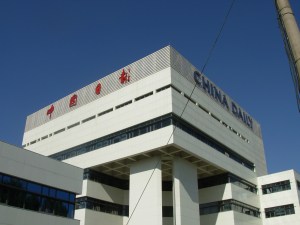
China Daily building 

Like millions of other Americans, by the summer of 2009 I faced financial ruin.

My biggest mistake was having chosen 30 years ago to embark on a career as a newspaper reporter. I was probably in the last graduate class of journalism students anywhere who used typewriters.

The first computer I saw was at my first newspaper job in 1981. Who foresaw those big, clunky boxes morphing into palm-sized devices, turning printed newspapers into 21st-century buggy whips?

My second big mistake was to leave a newspaper job at the age of 49 thinking I could get another one. I hadn’t realized that my 50th birthday would be like a brick wall between me and a newsroom.

Finally, the whole economy tanked, driving the last nail into the coffin of my career.

So there I was, with boxes full of front-page articles and magazine cover stories, a few nice awards, a master’s degree for the resume and not a chance in hell of finding a full-time job with a livable salary in my chosen profession. The low-wage, part-time jobs I’d scraped up had just delayed the inevitable while depleting my savings. A few thousand dollars stood between me and foreclosure, then homelessness or moving in with a relative.

My long-time buddy Renee, a fellow survivor of news organizations, joked that we would live out of neighboring shopping carts under a bridge in San Diego, where at least the weather was good. That was funny when it seemed unlikely.

In May 2009, I got a card from her that showed two women sitting on a couch, grinning: “A good friend will bail you out of jail. A great friend is sitting beside you saying, ‘Wow, that was fun!’”

Inside, she wrote that she was off to Beijing for a job at the English-language newspaper, China Daily. After she got there, she pelted me with emails describing the wonders of the Chinese capital: the Forbidden City, Tiananmen Square, the Silk Street Market, the neighborhood noodle shop where we could feast on fresh, hand-pulled noodles with beef and a locally brewed beer for $1.50. Why don’t you apply, she wrote, I’ll give you a reference. They’re hiring.

Renee had been there two months, but it was enough when combined with my resume to snag a job offer.

It came in an email from Mr. Pan, who ran the office that babysits China Daily’s English-speaking “foreign experts” and shepherds them through encounters with officialdom, like registering your address with the police. He offered a one-year job correcting the English of its Chinese reporters and editors at a salary of roughly $33,000 (at the then-current exchange rate), plus a rent-free, utilities-paid one-bedroom apartment, health insurance, 20 days off for Chinese festivals and plane tickets for one trip to Beijing and one back home a year later.

By then, I hadn’t had a full-time job or health insurance for seven years.

So saying yes to an offer that would keep me going financially for a while longer, plus let me experience China with one of my closest friends and on someone else’s dime, was a no-brainer. Only later, after eagerly accepting the offer, did I wonder whether working for a dictatorship on one of its propaganda organs might be hard.

But that niggling concern got shoved aside while I concentrated on the details of preparing for a year in China. These included getting five vaccinations, obtaining a year’s supply of a prescription medicine, buying an enormous suitcase and pressing relatives into duty as caretakers for my pets, my house and my small pet-sitting business.   http://datelinebeijing.wordpress.com/2010/12/21/what-to-do-before-leaving-for-beijing/

As I quickly learned once in Beijing, there is no such thing as a free press in China, or freedom of expression. China Daily articles tended to range from public relations hype to outright propaganda.

Taiwan, for example, is not called a country. It’s an “autonomous region.”

The Dalai Lama is a “terrorist,” and Tibet was “liberated.”

Advertising is routinely written up as news, and it’s standard practice to sell or trade space on so-called news pages for articles that here would be labeled as advertising.

The continual distortion doesn’t always sink to the level of propaganda, but it does leave the paper resembling a chamber-of-commerce publication.

Mercifully, the jobs of foreign reporters and editors typically are limited to the point that they do no significant reporting or editing. Chinese reporters (with some brave exceptions) are little more than stenographers, dutifully recording the story line as presented by officials and businesses.

Why, you may be asking, would any self-respecting foreign journalist participate in this?

We needed jobs, and needed them badly enough to go all the way to China for them. Although the younger expatriates generally were just enjoying the adventure, the older ones were trying to hang onto houses, or help their kids through college or recover retirement savings lost to suddenly worthless investments and disappearing pensions.

When I got home a year later, I couldn’t stop talking about China. For months, the most mundane events – shopping for groceries, going to a movie, eating out, waiting in line – prompted anecdotes about how differently people do those things in China.

What most surprised everyone was hearing what the Chinese believed about us. People here don’t realize how little the Chinese know about us (and how little we know about them) until they hear some of these anecdotes. One described an after-work chat over beers that left my expat friends and our young Chinese co-workers slack-jawed with amazement about each other’s countries.

Reports that millions of Chinese visitors to the 2010 Shanghai Expo were mesmerized by its water fountains amused and puzzled the expats. Our Chinese co-workers didn’t understand why the fascination with water fountains wasn’t obvious to us. Most Chinese (and all expats) drank only bottled water because even after boiling, tap water throughout China contains too much sediment to be swallowed. Drinking the equivalent of tap water without boiling it first was a novel experience for Chinese, they said.

We wouldn’t have thought of that, one of us answered, since we’re don’t have to do that at home.

Our Chinese friends looked stunned. Do you mean you drink water right out of the tap, without boiling it? Yes, we answered, in fact it’s required to have drinkable tap water for any dwelling to be considered legally habitable. They clearly wanted to believe us and just as obviously didn’t.

This was one result of severe restrictions on information about the world outside China. In combination with decades of government lies about the United States, such as telling Chinese in the 1950s that children in America were starving, even the most educated, computer-savvy urbanites have trouble telling truth from fiction. They know they’re lied to and are cynical about the government and their news media, but they’re still affected by the propaganda inundating them.

Before concluding that this doesn’t happen here, keep in mind how many Americans believe claims that Barack Obama is a foreign-born Muslim socialist who wants to subject sick people to death panels.

People kept telling me, “You ought to write a book.” (Maybe they wanted to shut me up.) I resisted. Plenty of people, more knowledgeable than me, have written excellent books about China.

Yet some of those books promote a view about China that even a brief sojourn like mine would call into question. One of the most common is that China is a powerful nation whose progress out of Third-World poverty threatens the United States. The Chinese certainly want to believe that, and its government insists this is so.

It’s the conventional wisdom. But what I saw suggests the common-sense conclusion that China will not be strong or rich enough in this century to threaten anyone except the smaller countries that share a border with her. China’s internal challenges are overwhelming, and will suck up every bit of money and effort available to keep them from swamping the country. There isn’t any of the surplus needed for international power.

China is a paper dragon, projecting an illusion of power far greater than its substance. Internationally, its allies are the rogue state of North Korea and some of the poorest countries in Africa, which can be cheaply cultivated by relatively affordable investments.

The highest priority of the Chinese government (topped by nine old men whose dictates rule 1.3 billion people) is maintaining its one-party dictatorship. Its attention, money and policies are devoted to this end, with control of its citizens as the means. All else, including international opinion, is a distant second.

Their methods, very roughly, boil down to three strategies: control information about China’s past, current conditions and the world beyond its borders; prevent citizens from organizing so much as a block club that isn’t sanctioned by authorities; and squash dissent. Transgressors suffer punishments ranging from loss of jobs, harassment and house arrest to beatings, imprisonment and execution. Their children and their children’s children are marked as unreliable and kept out of good schools and skilled jobs. For generations, they’ll suffer from a big, black mark made in their permanent political files.

Here in the U.S., kids snigger over threats made by exasperated teachers that misdeeds will be noted on their “permanent record.” In China, there really are such documents, compiled for every Chinese citizen which none is allowed to see.

Even with a cushy job like I had, its greatest benefit came to be the comforting knowledge that I had a guaranteed exit from China.

Next chapter coming soon: culture shock

AM I OLD YET?

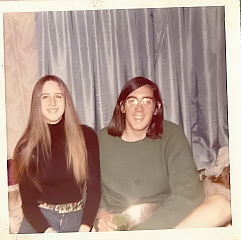
Me and my college boyfriend in 1972

Me at 20 with my college boyfriend in 1972

I was 28 the first time someone suggested I was no longer young.

He was an undergraduate at the university where I was a graduate student in journalism. We were waiting in lines to register for classes, as was done during those pre-digital days.

“Excuse me,” he said, “did you used to be a model?”

This was like asking a guy whether he used to be an athlete – a kind of back-handed compliment that hit the ego’s funny bone enough to twinge, but not so much as to hurt.

Until then, the question had always been “Are you a model,” something that started when I was 16 because I’d been tall and skinny during the Twiggy era and beyond. I never was a model, and although I’m still tall, my skinny days are long gone.

Next time the question of age came up, I wanted to score half off the price of a $12 lamp at Goodwill by taking advantage of its senior-citizen discount. The clerk didn’t think I looked old enough. She carded me to make sure I met the minimum age of 55.

My maternal grandmother, when that age, would not have been questioned. Her gray hair, shapeless house dresses and sensible shoes proclaimed her senior citizenship. My paternal grandmother, even with her dyed hair, manicured nails and stylish wardrobe, thought herself old when she hit 50.

I can’t imagine either of them would have been willing, at the age of 57, to take a job in Beijing for a year, as I did. They would have been physically able, but mentally unequipped.

“The very idea,” I can hear one of them say, “at my age!”

At the age of 61, I expect to live another 25 years or so. My parents, at 86 and 84, are unquestionably old, but they’re still active, pretty healthy and keenly attuned to current events.

When I reach that age, nobody will have to tell me I’m old. But I’m hoping that we Baby Boomers revolutionize old age as our demographic morphs into a Geezer Glut.

A few of my childless, single friends and I fantasize about eventually living together in a bad-old-broads commune. We’d pool our assets, buy a nice place where we could each have our own bedroom and bathroom, and divvy up chores according to ability and interest. At the end of each day, I’d be in a rocking chair on the porch or in front of the fireplace with a shawl around my shoulders, gumming a pot brownie while “Gimme Shelter” blasts through the earbuds of the latest audio gadget.

That’s my goal – to be old enough to know better, and still able to enjoy; to hear some whippersnapper in her 50s, shocked and appalled, scold me about being too old to behave like that.

Rock on, biddies, rock on.

End Times for God’s Own Party?

Hurricane Isaac: coincidence, or divine wrath?

The hand of God has reached out and smote the GOP with righteous wrath. Yea, even as Republicans struggle through the electoral valley of demographic decline, they are plagued by signs of divine displeasure.

 In little more time than it took Him to make the Earth, the Republican Party has been unraveling from blow after self-inflicted blow:

 -Prophet Paul Ryan’s starve-the-beast budget plan sounds to many voters like a fatal dose of snake oil;

 -Formerly devout members of God’s Own Party, such as Olympia Snowe, were driven from the fold. Charlie Crist, for the apostasy of joining the infidels who will gather in Charlotte, you are forever cast out of Bohemian Grove;

 -The serpent-tongued Todd Akin spake the truth of GOP beliefs about Eve’s wily daughters and their mysterious bodies, then tried to deny he meant what he said;

 -And finally, Hurricane Isaac descends on the Gulf Coast to pound retribution on Republican heads in Tampa for the sins of George, who was cast into the wilderness.

 Woe to thee, Republicans, for you’ve sorely tried the patience of all. Come November, you shall reap the whirlwind sown by your ideologically pure Christian soldiers, who will march the GOP right to its End Times.


The Royal Grump presides over a crashing bore

London’s opening ceremony for the 2012 Olympics was just plain awful. Mary Poppins? The National Health Service? The Industrial Revolution? Ranging from incomprehensible to bizarre, its various parts melded into one marathon bore, reducing British history to chamber-of-commerce boosterism.

Maybe that’s the best anyone could have made of it. As material for a spectacle, much of British history isn’t suitable for an event that emphasizes peace and brotherhood. The same can be said of most countries, perhaps all – an excellent reason to avoid self-congratulatory posturing in favor of a warm welcome and a good show that celebrates Olympic ideals.

Wouldn’t you love to have seen what John Cleese or Eddie Izzard could have done? Only Daniel Craig, Paul McCartney and (if you’ve acquired a taste for him) Rowan Atkinson managed to inject a bit of entertainment.  

Show director Danny Boyle owes an apology to the thousands of volunteers who devoted their time and efforts, only to be made to look silly. And someone needs to tell Queen Elizabeth it would have been ever so much more polite to all those performers, and the athletes who’d earned a chance to be there, if she’d tried to look like she was enjoying the results of their hard work.


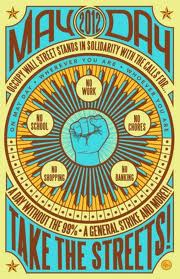
No more excuses: Get mad and get busy for May Day 2012

“I don’t have time. It won’t make any difference. What would my family/boss/co-workers/neighbors think?”

It’s always easy to talk ourselves out of taking action. But if you’re willing for just one day to stop talking yourself out of doing anything about the problems afflicting us all, including you, then this Tuesday, May 1st is the day.

May Day, born in Chicago in 1886 during the push for an 8-hour workday, has become an international holiday honoring workers. This year, the Occupy movement is suggesting and orchestrating protests ranging from quiet, individual acts to mass demonstrations.

So Tuesday, May 1st is when to do it. Here’s how: Get mad.

It shouldn’t be hard. All of us in the 99 percent have been screwed over one way or another, and often more than one way. Anger is the best means of overcoming inertia or hopelessness, which probably is why so many authorities constantly caution us against the “dangers” of anger.

From best-selling authors to preachers in pulpits, those who claim to know what’s best for us warn that anger will hurt us. We must move on, leave it behind, forgive and forget or risk the terrible consequences of a supposedly corrosive, self-destroying emotion.

Even assuming all of these people are well-meaning and sincere, the advice is misguided. In fact, it’s baloney.

Anger is the bedrock of a so-called bad attitude. And throughout human history, people with so-called bad attitudes have propelled some of the biggest advances in society by defying authority and protesting injustice.

Anger surfaces at the moment delusion dies, helping clear the fog of lies, half-truths, wishful thinking, propaganda, denial and conventional wisdom to reveal stark reality.

Anger is the fuel that propels people to act, and to persist in spite of obstacles ranging from ridicule to death threats.

What caused slaves to run away or revolt, women to protest, workers to organize? They were monumentally pissed off and tired of not doing anything about it.

Anger is not to be confused with rage, bitterness or hatred. As energy, it is best used when cool and harnessed to a thoughtful plan of action, instead of letting it drive you to lash out in a heated reaction of the moment.

So get mad and don’t let anyone try to talk you out of your anger. Plan how you want to act on it.

You might be surprised, afterward, by how much better you feel. Isn’t that reason enough?

Here’s a link to suggestions on how to spend your May Day 2012: http://www.occupytogether.org/

If fundamentalist culture warriors won…

How would life in this country change if religious fundamentalists managed to “take it back?” A few predictions:

 The nation would be christened the United States of Christian America.

 Independence Day would be replaced by a day commemorating our rebirth as God’s favorite country.

 The Constitution would be discarded, the Supreme Court abolished and the Bible enshrined as the law of the land.

 Under “Stand Your Ground for The Unborn” laws, women could legally shoot their doctors dead for mentioning the health hazards of unlimited pregnancies.

 Due to the impending Apocalypse and Rapture, the Environmental Protection Agency would be abolished as irrelevant.

 The Department of Christian Education would forbid lessons on sex, evolution and environmental science while requiring curriculum on abstinence, Genesis (either version) and humanity’s right to use the planet however it wants right up to the End Times.

 An “infidel brain drain” of academics, researchers, scientists, executives and artists to other countries would leave us dependent on people with degrees in Bible studies.

 To meet a Christian Communications Commission (CCC) mandate to uphold the sanctity of traditional marriage and families, broadcasters would present endless reruns of “Father Knows Best” and “Cheaper by the Dozen.”

 All forms of commerce, business and entertainment except for religious broadcasts and reruns of “Father Knows Best” or “Cheaper by the Dozen” would cease from midnight Saturday to midnight Sunday.

 Facebook’s biggest growth in pages would be for prayer circles. Popular phone apps would include “Ultimate Heretic Hunters” and “Born-Again Birthday Cupcakes.”

 Contraceptives would be illegal. Abortionists and homosexuals who failed to heed loving Christian appeals to renounce their sinful ways could be executed.

 The “War on Porn” would beget a black market in banned books, DVDs and contraceptives, which would beget billionaire crime bosses.

 Christmas ornaments failing to meet the “Jesus is the reason for the season” standard would be banned.

 Halloween would be marked by prayer vigils and re-enactments of the Salem witch trials.

 Prisons would be turned into Christian re-education centers and executions (by hanging or stoning) would be public.

 Adults who failed to reproduce would pay deadbeat taxes as noncontributing members of society.

 In addition, single females 18 years or older would pay a spinster tax until they entered holy matrimony.

 Applications for jobs, college, passports, drivers licenses, marriage licenses, mortgages, leases, credit, loans, government benefits, guns and library cards would require checking one of the following boxes: “Born again,” “Christian,” or “Heretic.”

 Checking “Heretic” or failing to check any box would be grounds for denial of the application.

 Rates of depression, domestic violence, suicide, alcoholism and drug addiction would skyrocket, while funding for any form of treatment except prayer would disappear. 

 Our borders would be closed to any immigrants who didn’t swear they had accepted Jesus as their personal savior. The Department of Holy Land Security would deport alien heretics.

 Mexico and Canada would plead for help in coping with millions of illegal immigrants seeking asylum from oppression in God’s favorite country.

What that iPad really costs


Between a factory tour by ABC’s “Nightline” and an investigation by the Fair Labor Association (FLA), it might appear that something is actually being done to help the subsistence-wage Chinese workers at Foxconn who make products for Apple, Hewlett Packard, Dell, IBM and others.

Don’t buy it.

Chinese workers contend with a level of competition for jobs that is simply unimaginable in less populous countries. They accept dismal conditions because they must.

What most Westerners probably don’t know is that Foxconn’s factory complexes also house and feed their workers – barely. Living space is a cot in a room crammed with others. Meals are mostly rice and watery soup. Workdays of 12 hours or more, six or seven days a week, are typical. Permission to leave the grounds often is denied.

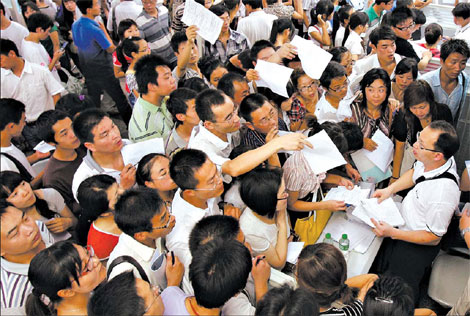
Even so, Chinese job-seekers mob Foxconn recruiters wherever they appear.

Two years ago, a Chinese reporter for an English-language newspaper in Beijing wrote a revealing article that described what it took to get one of those highly sought-after jobs at Foxconn. Here are a few excerpts, with a link below to the whole article:

“If your diploma is not genuine, you will be asked to pay for a fake one at a cost of 10 to 100 yuan, depending on how deep your wallet is perceived to be.”

“You will be taken to a minivan of 11 seats. About 18 people and all their luggage will be on board, so travel light and try to find a spot with breathing room.”

“The driver will escort you inside the training center, where harsh-looking men and women in uniforms await…You may be shouted at, intimidated, humiliated and bullied. …be obedient.”

“You will be taken across the street for body inspections. All you need to do is be obedient, stand straight and wait until you are ordered to go inside.”

“Note that you will be waiting with 1,000 others, so be patient and ignore the sweat. Don’t worry about the blood exams.”

“…you will be taken to a dormitory and assigned a bed in a room of 10. You should now be used to the smell of sweat, so bear with it.

“The orientation goes on for two days. Make no attempt to challenge the authority of anyone in uniform…”

“You will be given a badge and assigned a unit to work in at the end of the second day. Work starts the following morning with no prior training.”

Finger-shaking from the FLA might elicit promises of compliance with higher standards, but those won’t be honored by Chinese bosses.China is a lawless society, with no reliable way for complaints to be heard or rights to be protected. Demands, suggestions or recommendations from international groups and Western businesses will be rejected as improper meddling.

They just wait out sporadic spates of public attention, which don’t last long, then go back to business as usual.

Remember, Foxconn’s response after 10 workers jumped from their dormitories to kill themselves was to put up nets.

Sources:

Top photo of Foxconn job seekers from China Daily

“Fees, humiliation part of getting wired to Foxconn,” by Hu Yinan, China Daily – http://www.chinadaily.com.cn/usa/2010-06/01/content_11019305.htm

Foxconn job seekers doing pushups- http://www.chinadaily.com.cn/photo/2010-03/25/content_9643599.htm

 “We mostly found people who face their days through soul-crushing boredom and deep fatigue,” wrote Nightline host Bill Weir in a story previewing the show. http://www.foxnews.com/scitech/2012/02/20/apple-foxconn-offer-world-glimpse-into-chinese-manufacturing-plants/

http://www.fairlabor.org/fla/go.asp?u=/pub/mp&Page=FLACodeConduct


American jihadist

Don’t let the dorky sweater vest fool you. Beneath that benign-looking garment beats the heart of an extremist, a radical more akin to the Islamic fundamentalists of the Taliban and the ultra-orthodox Jews of Israel than to mainstream Americans. If Rick Santorum and his fundamentalist fans ran this country, we’d have a Bible-based theocracy thrust upon us, a dictatorship of the most divisive, judgmental and intolerant among us.

If you believe that contraception is immoral and any sex except conjugal attempts to procreate is sinful, he’s your guy.

If you think “abortionists” (that inflammatory, demonizing term for doctors who perform a legal operation) ought to be punished, he’s your guy.

If you think our Constitutional rights ought to be limited to conform with Biblical precepts, he’s your guy.

Already, a state legislator in North Carolina (who said on taking office he’d pray for the Lord’s guidance) has suggested public hangings for doctors who do abortions, lumping them in with rapists and kidnappers.

Already, fundamentalists in state legislatures are trying to give legal personhood status to the unborn “from the moment of conception,” however that would be determined. This would enable birth control, abortion and even in vitro fertilization to be criminalized.

Phyllis Schlafly of the Eagle Forum wants single mothers and parents of adopted children punished with higher taxes as a way to promote “traditional” families, which she defines as married heterosexual couples raising their own children.

All this under Obama. Imagine the impetus of having a kindred spirit in the White House.

An exhaustive, five-volume study of fundamentalism worldwide edited by two Americans argues that it’s a political phenomenon and is inherently totalitarian. Its goal is to realign all aspects of a nation’s society and government according to rigidly defined and strictly enforced religious principles. There’s nothing democratic or broadly representative about it.

Rick Santorum has a right to his views and is entitled to run for President. Should he win, however, we’ll see a holy war against the right to live without religious interference.

Sources:

Photo by Associated Press

Rick Santorum’s views: www.ricksantorum.com

“This is about a country that believes in God-given rights, and a Constitution that is limited to protect those rights.” http://www.washingtonpost.com/blogs/election-2012/post/rick-santorums-missouri-victory-speech-full-transcript/2012/02/07/gIQAGcUwxQ_blog.html

 “(Contraception is) not okay because it’s a license to do things in the sexual realm that is counter to how things are supposed to be. They’re supposed to be within marriage, for purposes that are, yes, conjugal… but also procreative.” http://www.theatlantic.com/politics/archive/2012/02/rick-santorum-wants-your-sex-life-to-be-special/253104/

 Public hanging comment by Larry Pittman, Republican, North Carolina: http://www.wral.com/news/state/nccapitol/blogpost/10649801/

Rick Santorum’s signed Personhood pledge: http://www.personhoodusa.com/files/Keith%20Ashley/Santorum_Personhood.pdf

Phyllis Schlafly on marriage and taxes: http://www.eagleforum.org/column/2012/jan12/12-01-18.html

The Fundamentalism Project: http://www.illuminos.com/mem/selectPapers/fundamentalismProject.html