Next on tap – the Chinese Museum of Clean Air?

The sign beneath this outdoor water pump at the Beijing Museum of Tap Water supposedly warns visitors not to drink the water.

The sign beneath this outdoor water pump at the Beijing Museum of Tap Water supposedly warns visitors not to drink the water.

China, you may have heard, has been on a building blitz of gigantic proportions. Apartment buildings, skyscrapers, business parks, gated communities, monuments, museums, theme parks – all the infrastructure needed for burgeoning masses of proletarians turned consumers.

Among all these oversized projects is the humble Beijing Museum of Tap Water. It’s a most peculiar choice of museum subject, given that nobody in that huge, populous country enjoys plumbing that delivers potable water.

That’s right. No drinkable tap water in the whole country.

Even after it’s boiled, there’s too much sediment to drink the stuff. Even with filters, it’s too risky to imbibe.  No filter can eliminate all the pollutants coming out of Chinese faucets, which include sewage, heavy metals, lead, rust, nitrates, nitrites, bacteria, viruses, parasites and extreme levels of chlorine.

According to the website China.org.cn, the museum’s tap-water objects “… are presented in front of the visitors who will truly understand that tap water is hard-earned.”

Imagine what sort of exhibits might be displayed in a Chinese Museum of Clean Air – photos of skylines doctored to scrub away the murky fog that passes for air, an assortment of face masks and sets of lungs blackened simply by breathing. 

Freedom to threaten, not to compromise

Gun extremists insist that liberty depends on unlimited access to guns. In their view, firearms protect their freedom of expression to  threaten a lifelong gun owner with death, but not his right to disagree with them. 

gun belt buckle

Gun journalist Dick Metcalf, 67, suggested in his  column at Guns & Ammo magazine that requiring 16 hours of firearms training for gun purchasers was not an unreasonable infringement of their Second Amendment rights.  Every constitutional right, he wrote, is regulated in some way. He used the old example of that well-known First Amendment limit on free speech that prohibits people from falsely yelling “Fire” in a crowded theater. More recent versions of this argument would be joking about blowing up an airplane while going through security screening, or posting idle musings on Facebook about which fellow students you might like to shoot.

Unfortunately for Metcalf, his editors fired him after caving to threats about cancelled subscriptions from outraged readers and loss of advertising revenue from gun makers.

Democracy requires consensus, a meeting on middle ground achieved through compromise on both sides. What gun nuts endorse, with their hysteria, distortion and willful refusal to acknowledge rational arguments, is armed-to-the-teeth anarchy.  Every person a law unto himself and no central authority to tell him otherwise – if that’s what they want, they might like living in Afghanistan.

Walk in these scuffed shoes, Wall Street Journal editors

jobless

The Wall Street Journal’s editorial page has tut-tutted 90.6 million Americans for being jobless, disabled, uninsured or broke enough to need food stamps.

They “aren’t even looking for a job,” sniffed the Journal, blaming this on too easily accessed social safety net components “that substitute for work” – unemployment insurance, disability payments, food stamps and (“soon”) Obamacare.

According to this view, only the threat of destitution will motivate workers to get jobs.

Why is it that, in this view, workers deserve the stick while executives are thought to merit the carrot of incentives?

Considering the kind of low-wage, dead-end drudgery produced by the ever-expanding “service economy” of burger flipping and bathroom cleaning, it’s understandable why motivation might be hard to maintain. Those seem to be the only kind of jobs that haven’t been outsourced by the hundreds of thousands to subsistence-wage workers in India or Mexico.

I propose a challenge for the Journal’s editorial writers: a one-month sojourn for each of them in the shoes of a laid-off teacher, a disabled factory worker or a single mother whose full-time job doesn’t pay a living wage or provide health insurance.

Move into their homes, shop for clothes with them at Goodwill, wait with them to see a doctor in a community health clinic.

Then tell us what you think based on your experiences, instead of offering judgments that substitute for first-hand knowledge.


STATE OF PANIC

Is it something in the water? Has heat addled their brains, or petrochemical pollution poisoned their perceptions? Instead of the strong, brave, hero types of Texan legend, we’re seeing two examples this week of Lone Star paranoia run amok.

texas secedes

First, we have the pathetic sight of Capitol security guards confiscating tampons and maxi-pads from the purses of women wanting to attend legislative debate on the state’s proposed abortion restrictions (which passed). Supposedly, guards had been tipped off that “proaborts” might fling feminine hygiene products at lawmakers.

Next, we learn that an anonymous donor paid the $500,000 bond set for 19-year-old Justin Carter after cops arrested him for a sarcastic Facebook post. When a fellow “League of Legends” gamer called Carter insane, Carter unwisely replied, “Oh yeah, I’m real messed up in the head, I’m going to go shoot up a school full of kids and eat their still-beating hearts.”

For this, he was jailed for months after being charged with making a terroristic threat. He’s due in court for a hearing on Tuesday, July 16th.

No sir, Texans don’t cotton to sarcasm or assault with female unmentionables.

Now stupid remarks (ala Gov. Rick Perry) and letting gun-toting Texans exercise their Second Amendment rights with as few restrictions as possible, that’s different.

Let Texas go, as 100,000 people already have urged in a petition to the White House. And make it take Florida with it.


Did Jew really say that?

merchant of venice

“Shylock, e.g.”

That’s the clue to 32 Down (three letters) in a crossword puzzle published yesterday and composed by Victor Barocas, a professor in the biomedical engineering department at the University of Minnesota. The answer is “Jew.” Shylock was a money lender in the Shakespeare play “Merchant of Venice,” who demands a pound of flesh from the guarantor of a loan who can’t pay.

Today, the Chicago Tribune’s customary publication of the answers to the previous day’s puzzle included an intriguing three-letter gap of blank spaces and this explanation: “…the answer to 32 Down has been blocked because it would make the combination of clue and solution an offensive stereotype.”

I, for one, was clueless about Shylock, having never read “Merchant of Venice.” Thus, I entirely missed not only the answer, but the offensive-stereotype link until the Trib’s note mentioned it. I had to Google “Shylock” to find out why the three blanked-out letters J-E-W (whose absences made the answers Sajak, oneG and byweight look like grins missing teeth) might offend anyone.

So the Trib’s note provided an educational opportunity about stereotypes and prejudice, but I wonder if blanking out the word “Jew” undermined it. By refusing to openly identify words used offensively, don’t we send a mixed message, signaling hesitation about confronting the mistaken beliefs which give those slurs power?

That hesitation can be taken as ambivalence, which signals we’re not sure of our ground.

If Paula Deen had said “N-word” instead of “nigger,” would she have sounded less prejudiced?

When is it okay to say nigger?

Paula DeenAs we all know now, Paula Deen, the doyenne of deep-fried cooking, has turned her career into toast. Blackened it, one might say, with a series of scorching admissions about her use of the word “nigger” and her proposal to throw a plantation-themed party with African Americans portraying slaves.

Amid the uproar, pundits, newscasters and bloggers routinely used the prettified phrase “N-word” when referring to the racist slur Deen slung around. The cautious resort to a euphemism isn’t the most effective teaching tool for conveying how objectionable the term is. If we’re too delicate to even say the word, how can we possibly educate the unenlightened?

Imagine trying to teach sex education using only “the I-word.”

As distasteful as Ms. Deen’s bigotry is, the rabid reactions of her defenders are downright astounding. To those who insist they “don’t understand” why Deen’s attitudes are so harmful, try this little exercise.

Imagine she was accused of disparaging fat people. She goes on TV to protest her innocence. Instead of saying (as she did) that one of her employees is black and asking him to come on out even though he might be hard to see because he’s as dark as the background of the stage set, let’s say she told him “Come on out here, if you can get through the door, and show people how fat you are.”

Or, let’s take the plantation-party plan a step further. Why didn’t it occur to Ms. Deen to suggest including some light-skinned slaves who look an awful lot like Ol’ Massa, played by her brother Bubba and some relatives with spray-on tans? And an overseer with a big whip? And a pack of baying bloodhounds?

Guess that didn’t fit into the happy slaves theme, and unhappy slaves would be no fun at all, y’all.

Life after China


CHAPTER NINE of “Commie wage slave,” in which I leave the Middle Kingdom to go home


 oz


Not a day goes by that I’m not happy to be home from China.


Every time I breathe the clean air and enjoy the blue sky of a sunny day; every time I use water from my tap without having to boil it first; whenever I wander the Internet with no restrictions, or read genuine news written by unfettered journalists, or just stand at my kitchen sink doing dishes without having to bend over because the countertop is too low: There are countless moments when I savor and appreciate everything I took for granted BC – Before China.


I expect that to continue for the rest of my life, along with a fascination for the country that developed during my year in Beijing. That year, the longest of my life, was a true character-building experience. I’ll always be glad I did it and even happier that it’s over.


Hobbled as I was by being illiterate in Mandarin and burdened by the silly suspicion that Americans were spies, it wasn’t possible to get close to any Chinese. A few of my Chinese co-workers, however, went out of their way to make me feel welcome and comfortable. A couple of them even had me to their apartments for dinner or for a lesson in making dumplings.


The latter was truly humbling. My hostess and her friend deftly filled, shaped and crimped shut dozens of dumplings in little time. My few, misshapen, lumpy and leaking, looked like things that might come out of an occupational therapy class for people with numb fingers.


The biggest difference between Chinese and Americans is attitude. The Chinese, after the national traumas of invasion and occupation, revolution and civil war, political terror, starvation and oppression, have no idea how good life can be. They know too well how bad it can get, while Americans are clueless about how many blessings we enjoy that aren’t obtainable in many countries.


My year in Beijing allowed me to pay my mortgage and save up a year’s worth of income. The money saved up turned out to be especially important, a fact that became brutally clear as soon as the customs agent in the San Francisco airport asked, What is your occupation?


“Unemployed,” I had to answer.


But that didn’t stop me from going straight to a concourse restaurant and happily spending $20 for a genuine cheeseburger, fries and a beer. The next day I’d start practicing frugality, but that day, I celebrated with guilt-free indulgence I’d spent a year earning.


Behind the Great Firewall

CHAPTER EIGHT of  “Commie Wage Slave,” in which I learn about the language of dissent in China

 An image of the mythical Grass-Mud Horse, symbol of Chinese resistance to censorship

Since Americans were thought to be universally rich, our explanations about being in China because we couldn’t get a job back home probably didn’t sound believable to our co-workers, which must have bolstered their suspicion that we were spies.

Never mind the fact that most of us spoke little or no Mandarin. Plus, it’s hard to imagine what kind of secret information anyone thought we could glean from editing news-like propaganda that was controlled and censored by state authorities.

But their assumptions about us have been shaped by generations of distortion and very limited access to information. The Internet doesn’t appear to have changed that yet.

As it has elsewhere, the digital age has created countless jobs in China. Unfortunately, many of them involve maintaining the Great Firewall. Untold thousands monitor websites, email and even text messages for forbidden content. Some write pro-government messages for bulletin boards and social sites.

At China Daily, expats ran into the Great Firewall all the time. It includes bans on Facebook, YouTube and Twitter, limits on content for websites and authorized search engines, plus constantly changing and secret lists of forbidden search terms. All Internet traffic into and out of China is closely watched.

Since authorities never publicize which words are forbidden, it’s easy to run afoul of their censors. Our Internet connections would disappear for a few minutes the first time we used a forbidden word in a search. If it happened again, we’d lose access for up to a half hour.

If the website we were trying to access contained a forbidden term, we’d get a “site not found” error message.

Sometimes you could guess which words might trigger this. When the Arab Spring started in Tunisia, for example, the word “jasmine” became a forbidden search term because of the phrase, jasmine revolution. Too bad if you were just searching for a local place to buy jasmine tea.

The Great Firewall so limited access to information from outside (and even inside) China that it wasn’t unusual to learn about events in Beijing from international news outlets – which, of course, could only be accessed with the aid of a proxy server that was outside the country. Expats equipped their own computers with these services. Thus, when Google threatened to leave China rather than censor its searches, we found out by reading the New York Times online that Chinese were leaving flowers, stuffed animals and notes of support in front of the company’s Beijing office. No word of this reached Chinese media.

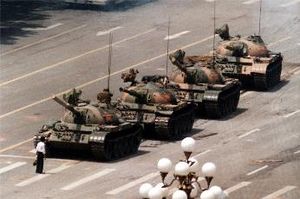
tank man

For a few hours during this tussle, it was possible for Chinese to access anything on a Google search, a novel and brief experience. The term “Tiananmen,” for example, brought forth the haunting photograph of the nameless Chinese man who confronted a line of tanks on their way to threaten thousands of demonstrators in central Beijing. It’s one of the most famous photographs of the 20th century. Most Chinese have probably never seen it.

We wondered, of course, whether there might be tiny cameras or listening devices hidden in our apartments. I never heard of anyone looking for them, much less finding one. But there’s no question that our computers at work were examined. It wasn’t unusual to sit down at the start of a shift, boot up the computer and discover that files were missing or rearranged, put in new places. No effort was made to hide this; making it blatant was most likely a deliberate part of the intimidation factor.

The longer we were in China, the more paranoid we became. The very atmosphere of the place made it inevitable. Thus, when democracy activist Liu Xiabo won the 2010 Nobel Peace Prize after I had already left China, Renee emailed me from Beijing. There was only a subject line: “Did you see who won?”

She feared that if she had mentioned the Nobel Peace Prize or Liu Xiabo, her email might not have gone through. Or, someone at China Daily might have detected it and alerted the powers-that-be about the need to monitor her communications (if they weren’t already). Maybe someone in the IT department or one of the countless monitors paid by the government to spy on communications, looking to curry favor, would report it to higher-ups. We don’t know how realistic these fears were when applied to foreigners, but they were raised by living in a place where advocating freedom of speech is prosecuted as subversion and even a word in a text message can lead to punishment. The possibility of unpleasant repercussions seemed plausible.

Nonetheless, Chinese netizens have found a way to use the Internet for robust debate, criticism and mockery of their government. Their solution is to use code words based on homonyms.

Thus, when they want to refer to the government or the Chinese Communist Party (CCP), they use the term “grass-mud horse.” In Mandarin, this sounds almost like the phrase, “fuck your mother.” Once you know that the CCP calls itself the mother of the people, the meaning of this code word is clear.

The grass-mud horse first appeared in 2009 and became a huge hit. Videos quickly appeared of the grass-mud horse battling the river crab, a code word that sounds like the propaganda euphemism, “harmony.” When censors have scrubbed forbidden content from a Chinese website, netizens say it has been harmonized.

Other code words are less obscure. June 4, for example, refers to the day Chinese tanks and troops attacked unarmed democracy demonstrators in Tiananmen Square in 1989.

For a thorough look at how Chinese netizens and dissenters use code words, check out the Grass-Mud Horse Lexicon at the website, China Digital Times, by clicking on this link – http://chinadigitaltimes.net/space/Category:Grass-Mud_Horse_Lexicon.

Also interesting is this video about the Grass-Mud Horse. If you watch to the end, it’s easier to understand. The language is foul, but indicates the level of frustration.  http://www.youtube.com/watch?v=3D2eh4xehc4

Coming next: Leaving China

ROUND EYES, BIG NOSES

CHAPTER SEVEN of “Commie wage slave,”  in which I learn how very foreign I am to one-fifth of humanity

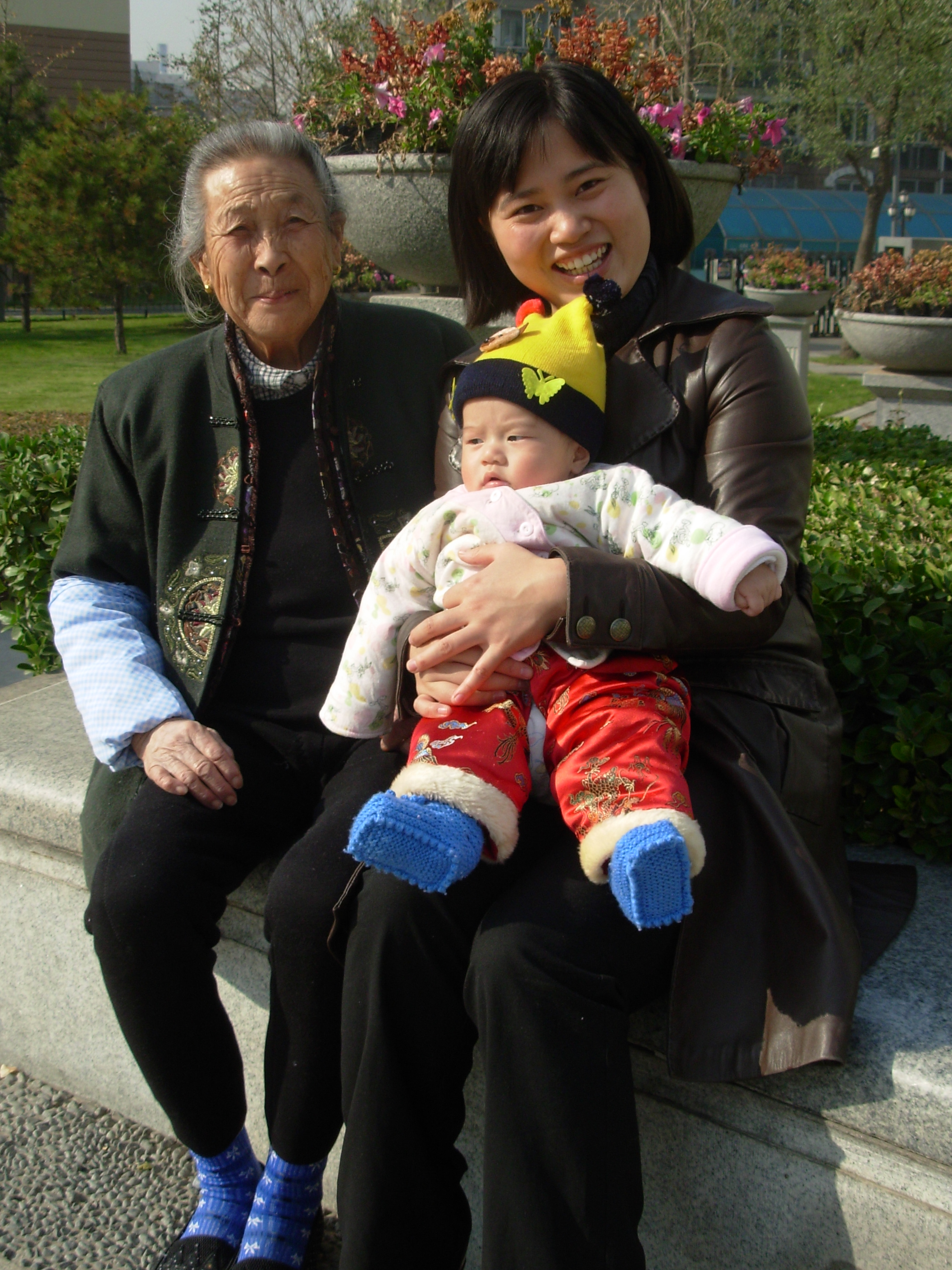
A China Daily employee with her daughter and her grandmother

A China Daily employee with her daughter and her grandmother


Beijing, as a nation’s capital, is home to its most prestigious universities and bustling with business people and tourists from around the world. So it surprised me how often I was regarded as an alien species.

I walked for miles in a nearby park almost daily without seeing another Westerner. When riding a bus or subway, or strolling through the campus of a nearby university, or shopping in a food market, places that swarmed with overcrowded Oriental humanity, it was very rare to see an Occidental face unless I was in the embassy zone or near a tourist attraction.

At times, this was a little unnerving because people stared at me all the time. Even in neighborhoods accustomed to seeing foreigners, Chinese stared at me openly and constantly. I figured they rarely, if ever, saw any female foreign devils as tall as me.

After a while, I could gauge the likely response if I smiled and nodded at someone who stared. People who were middle aged or older simply stared back, their faces blank. They grew up during a time of closed borders, Cold War and national paranoia about hostile Western powers.

Those in their thirties or so generally smiled back. They’re more aware of the world outside China, less fearful of it and often eager to see it.

The high school kids next door to China Daily appeared too shy to catch my eye. Very young children would turn their faces away and hide or even cry as if they’d seen something scary. Chinese parents must tell some awful stories about barbarians.

Their less pejorative terms for Westerners are “round eyes” and “big noses.”

We must indeed have looked immense. Chinese are very small, slender people. Even when wearing their heavy winter coats, the young security guards at China Daily looked like I could have picked any one of them up and snapped him in half with a good bear hug.

Buying women’s clothes off the rack was not possible for me and many other Westerners, unless we went to a store that catered to Russians. Even when we had items custom-made by tailors who supposedly had much experience with Western tourists, we couldn’t get clothes that fit. My friend Annette, who is slender enough to almost fit into Chinese clothes, went with me to a shop at the Silk Street Market, a well-known tourist destination. She wanted a suit and I was after a coat. We picked out patterns and material, were measured, paid for the items and were told when to come back for them.

Apparently, the tailor couldn’t believe what his measuring tape told him. Our new, custom-made clothes were too tight. Since the material for my coat had been cut too small, I was stuck with an ill-fitting cashmere coat that I ended up selling.

The contrast between American and Chinese women was startling in other ways, too. When something amuses a well-mannered Chinese female, she’ll softly titter while holding one hand over her mouth. The sight of American women laughing out loud, and without covering their mouths, appalled them. We seemed to them like braying donkeys.

We also had no inkling about how to behave with superiors. If I needed to ask my supervisor a question, I addressed her by her first name, instead of using her title and last name. When clinking glasses during a toast at office dinners, I failed to make sure my glass was lower than that held by someone higher up the food chain. My ignorance about these basic points of Chinese social etiquette simply seemed like bad manners.

Western women were just too large, too loud and too direct by Chinese standards of femininity.

Chinese men kept their distance from us, but Western men eagerly dated Chinese women. Western women watched these romances with distaste, knowing that when the man moved on, his Chinese ex would face disgrace and disapproval. To Chinese parents, it’s pointless and even harmful for a girl to date anyone who isn’t a possible husband. Chinese girls who aren’t married by age 27 are referred to as “leftovers.”

My status as a never-married woman with no children was regarded as freakish. No Chinese was so impolite as to say so, but you could almost hear them thinking, “A fate worse than death.” What I regarded as freedom and welcome solitude, they considered a pitiable state and an irresponsible lack of familial duty to my parents, who surely expected grandchildren.

That my parents never pressured any of their children to marry and reproduce would be unimaginable to Chinese parents, another shocking example of barbarian (meaning non-Chinese) behavior.


Coming next: China’s Great Firewall

Beijing’s cold wars

CHAPTER SIX of “Commie wage slave,” in which capitalist running dogs battle runny noses


The result of one dust storm on the floor of a patio at my Beijing apartment.

The result of one dust storm on the floor of a patio at my Beijing apartment.


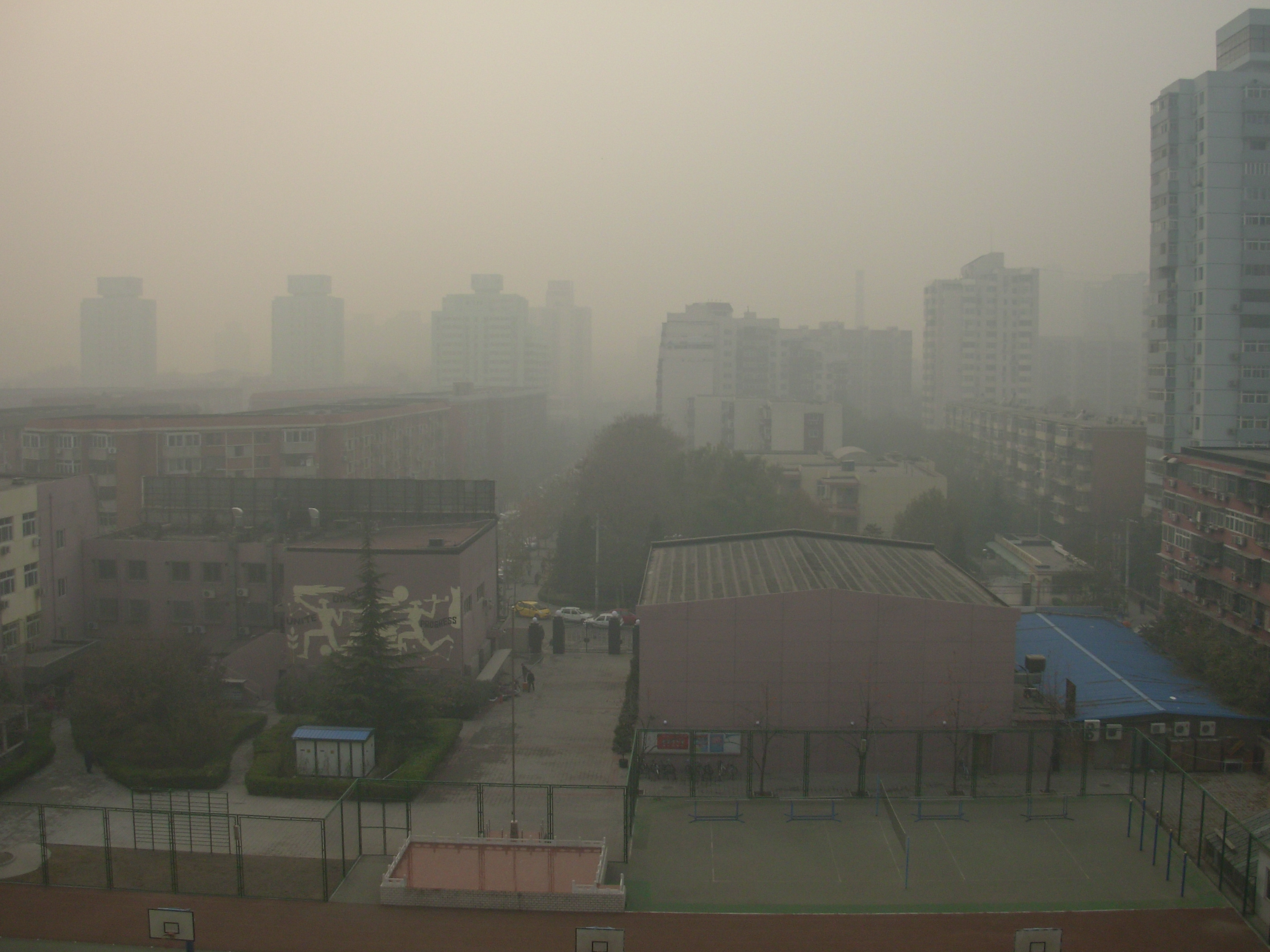
Smog obscures the view of anything more than one block away from my Beijing balcony.

Smog obscures the view of anything more than one block away from my Beijing balcony.

A month after arriving in Beijing, I gave up wearing contact lenses. The grit in the air made it too painful.

Some of it was sand blowing in from the encroaching Gobi desert. But much of it was pollution in the form of particulate matter big enough to scratch eyes and clog lungs.

In winter, the air in Beijing is especially dangerous. Cold-weather demand for heat greatly increases the amount of dirt spewing from China’s coal-burning power plants. Combine this with fumes from an astounding level of car traffic running on low-grade gasoline, and the result is sickening.

By January, the expats at China Daily had turned into mucus factories on overdrive. For days, we were forced to breathe through our mouths, carry big boxes of tissues everywhere and try to sleep sitting up, since any attempt to recline brought on coughing fits. We could feel the stuff bubbling in our lungs.

Those who smoked fared even worse. Some developed chronic bronchitis.

All of us needed to take a few sick days. To get them, we had to go to a China Daily-approved doctor and get a certificate attesting to our illness.

Imagine the fun of this, feeling sick as a dog but having to haul yourself up, stumble out into the cold and hail a cab to drive you the whole two blocks to the China-Japan Friendship Hospital, our designated healthcare provider. Like everything else in Beijing, their blocks are huge. Walking two of them while sick was to be avoided.

There was almost another block to walk at the hospital, where the wing devoted to treating foreigners is at the far end of the place. Supposedly, the staff speaks English. In reality, they know a few words. They can ask whether you speak Chinese or Japanese. Mostly, they gesture and point when communicating where you should go next.

Your first stop is at an intake desk. The workers there wear face masks. As soon as you tell them you have a runny nose and cough, they hand you a mask and insist you wear it.

It’s amazing how much of an impediment that small piece of cloth can be. Your face gets very hot because your breath is trapped under it. Just enough escapes out the top to fog your glasses. It’s hard to make yourself heard, especially if a scratchy throat and cough already have played havoc with your voice.

It’s cold in the hospital. The nurses and doctors wear sweaters and jackets while they work. Garbage has blown in through an open door. It just sits there. Sunken old couches and chairs line the hallway outside the doctors’ offices. This is where you wait, breathing into that damn mask.

The doctor, a nice woman, sticks a tongue depressor in your mouth and tells you to say “ahhh.” Then she pulls out a stethoscope and listens to your lungs – right through your clothes, even if those include a thick sweater and bra. She wants blood drawn, gives you a piece of paper and points towards the nurse’s station. The nurse points to the cashier.

You will go to the cashier every time a doctor wants a test done or a medicine prescribed. Nothing is provided until you’ve paid for it in cash, upfront. When you have a receipt for payment, you go back to the nurse’s station to proceed with the test. Then, prescription in hand, you once again go to the cashier. Receipt in hand, you can go to the pharmacist. She speaks no English at all.

Our Chinese colleagues routinely warned us to insist on prescriptions for Western medicine, not “TCM” – traditional Chinese medicine. For colds, this would include herbal teas, miso soup or concoctions containing cinnamon twig, ginger root, kudzu root and licorice.

Their pharmacies were fascinating, with big glass jars of chrysanthemum flowers, mulberry leaves, forsythia buds, lavender seeds and rosehips, among many others. There were boxes of teas, bottles of honeys and tablets made from fruit, leaves, flowers and bark for everything from weight loss to “Heat-clearing and Fire-draining.”

Glass cases displayed bones, antlers, claws and horns, many of them from endangered species.

Western medicines are very hard to find and very expensive when you do find them. It’s cheaper and safer to have them bought in America and shipped over. Chances are much better you’ll get the real McCoy, instead of an ineffective knockoff.

For some reason, the Chinese are particularly wary of antihistamines. They also regard blowing one’s nose into a tissue as a disgusting Western practice, while Westerners are appalled by the Chinese habit of emptying one’s nostrils right on the street, snorting clear first one, then the other.

One of our Australian colleagues had the bad luck to be hospitalized with appendicitis. It had to be removed.

During his stay, he was required to pay cash every day before midnight. He would throw a coat over his pajamas and, holding his fresh stitches together, tramp all the way out to the street where he could withdraw yuan from a bank ATM, then hobble back to his hospital bed.

Even though we had insurance from our employer, the best healthcare solution was the same as for those back home with no insurance – don’t get sick.

Coming next: Round eyes, big noses