
Chicago Tribune standards editor elevated to mystery job

Today’s weather page in the Chicago Tribune looked free of errors for the first time in days, until I got to the forecast for Monday, Feb. 2: “Light southerly winds strengthen and become more SE at”

On today’s business page, the paper announced that “Margaret Holt, 63, will be elevated to recognize her role as standards editor for the newspaper.” This brief clause in one sentence is the only mention of Holt in the article, a lengthy description about five senior editors and their new jobs at the paper. The other four editors got a lot of attention: detailed descriptions of their past experience, explanations of their new jobs, compliments from upper management and quotes from the newly promoted editors about how they view their jobs.

How curious that Holt got none of this treatment. The article didn’t mention what her “elevated” role is to be, whether it will include her current duties or if the role of standards editor itself is being elevated.

Her Tribune bio says that as standards editor, she “works closely with reporters and editors about issues of accuracy, fairness and ethics.”

Too bad that the announcement of her promotion didn’t, in all fairness, give readers the same thorough reporting about her as about the other four. Perhaps an insult was unintentional, but an oversight of this size smacks of a put-down. Of course, someone whose job is to wield a critical red pencil and a sharp eye for mistakes is handicapped in any popularity contest. Or, perhaps she is held responsible for the frequency of errors and the paper didn’t want to raise that question in any description of past performance or future duties.

At a 2005 conference called “Editing the Future: Helping Copy Desks Meet the Challenge of Changing Media,” Holt described how the Tribune in 1995 began focusing on eliminating errors. It carefully tracked mistakes, categorized them and devised staff training to prevent them. Judging from its track record lately (and not just on the weather page), the Trib appears to have lost that focus.

The prevalence of typos, spelling errors and mangled syntax could be a result of the Trib’s squeeze-the-newsroom business model, rather than deficiencies in individual staffers, who probably feel frustrated and discouraged. These kinds of errors are characteristic of a business whose standards have slipped far enough to damage credibility with its readers and its industry.

As Holt wrote in a “Focus on accuracy” essay for that 2005 conference website, “We can never take these basics for granted. They jeopardize our business.”

Chicago Tribune death watch

“Lake-efect snow potential late Sunday”

Photo by  bizjournals.com

Photo by bizjournals.com

“Pattern shift suggest temperature downturn late next week”

Both of these come from the paper’s weather-page graphic by WGN-TV, a Chicago Tribune property. Both appear to have been composed by someone for whom English is a second language and then published without the benefit of copy editing.

As every die-hard delivery customer knows, the Chicago Tribune has shriveled in size and deteriorated in quality. Publishers blame shrinking revenues caused by the Internet luring away advertisers. But that explanation doesn’t go deep enough.

Readers and advertisers abandoned newspapers because, like dinosaurs, newspaper publishers couldn’t adapt to a new environment. They clung to an old business model that included spending as little as possible on the newsroom. This worked well enough when times were good. Now that times are bad, they’ve doubled-down on it, starving the newsroom much like conservative Republicans aim to shrivel government by refusing to fund it adequately.

Newspaper publishers (not all of them, but in general) tend to loathe newsrooms, regarding them as nothing but overhead full of employees with bad attitudes who bring in no money but produce plenty of complaints from government officials and chamber-of-commerce types. When revenues began to tank 10 years ago, their first instinct was to cut newsroom budgets, lay off reporters, copy editors and photographers, outsource or centralize editorial functions, hope to get by with lower-paid, less experienced staffers and demand more work from them.

In the last gasps of its death throes, the Chicago Tribune still has produced some outstanding exposes, such as its stories about the ineffectiveness and dangers of a red-light camera program shot through with corruption. Imagine what it could do if it reinvested in its core function of delivering news, redefined its mission as in-depth explanation and analysis and gave up publishing a print edition of “daily” news already outdated by digital sources the day it’s printed.

It even enjoys the advantages of a huge market free from any competing papers and a large pool of unemployed, experienced ex-newsroom staffers.

All it needs is a publisher with imagination and guts.

State of the unions 2015

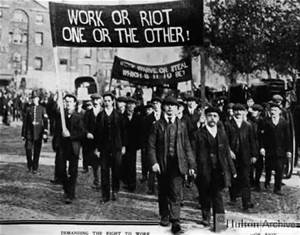
labor unionPresident Obama used his 2015 State of the Union address to describe how he hopes to help middle-class Americans struggling with low or stagnant wages, poor job opportunities, staggering college costs and unaffordable health care.

One of the answers to these problems lies in revitalized labor unions.

After decades of continual corporate assault on collective bargaining rights, union membership in the United States has fallen from a high of 35 percent of the workforce in the mid-1950s to less than 12 percent. The power of unions helped American workers – including those who didn’t belong to unions – gain their fair share of the country’s post-war prosperity, and it didn’t prevent American companies from growing into international behemoths.

They aren’t perfect. Like all large, powerful, wealthy organizations, successful unions have harbored the same kind of greedy, corrupt officials found in business, government and sports. Even so, unions propelled some of the biggest advances in working conditions involving safety, pay and fairness. Their members shed blood and died from attacks by police and troops during strikes to wrest improvements from employers.

Next time you’re told wage increases, full-time hours, regular schedules, paid vacation time, sick days, parental leave and affordable health insurance will make your employer’s business “less competitive,” take a few minutes to check out what advice or help a nearby union local might have. Here’s a place to start:

http://www.aflcio.org/Learn-About-Unions

“What can anyone do about it?”

Between Oxfam’s report claiming that 1 percent of the world’s population will soon own 50 percent of its wealth and perennial presidential candidate Mitt Romney’s new packaging as an anti-poverty warrior, it’s understandable if most people just want to throw up their hands (and maybe their latest meals) in utter frustration, discouragement and anger.

Naturally, if you’re not among the 1-percenter billionaires, it’s easy to think that no individual could possibly make a difference in anything. But that kind of I’m-on-my-own thinking is precisely what keeps people from acting. It’s no coincidence that those few at the top of the income scale insist that individuals alone are responsible for overcoming all obstacles to improving their situations, that unions and government regulation threaten freedom and that their own advantages of wealth, the best schools and knowing the right people had nothing to do with their success.

But we’re not helpless.

Take one hour a week and do the following:

1. Pick a couple of potential candidates for elective office and find out how they voted in the past on taxes, regulation of banks and Wall Street, student loans, unemployment insurance, the minimum wage, Medicaid, corporate incentives and other pocketbook issues. Never mind what they say. Past actions, not campaign promises, are the best predictors of what they’ll do in the future.

2. If you find a candidate whose voting record pleases you, spend that weekly hour working for his or her campaign.

3. Don’t overlook people running for local offices. They have a great impact on where you live.

And just for fun, take a look at how self-described capitalist tool Forbes magazine tries to discredit the statistical validity of Oxfam’s findings. Using Oxfam’s charts, Forbes proclaims that there isn’t enough data to reliably predict when or if Oxfam’s 50-percent conclusion will come true. What the charts show has already happened, however, is that between 2000 and 2014 the world’s 1-percenters owned between 44 percent and almost 49 percent of the globe’s wealth.

http://www.forbes.com/sites/timworstall/2015/01/20/oxfams-still-wrong-about-the-global-1-and-all-economic-growth-flowing-to-them/

http://www.oxfam.org/en/pressroom/pressreleases/2015-01-19/richest-1-will-own-more-all-rest-2016


Introducing Forked Tongue: Don’t say what you mean

With admiration for the annual Doublespeak Award given by the National Council of Teachers of English, I offer a modest effort called Forked Tongue. It will be a category of posts about words people use to obfuscate what they really mean.

The inaugural entry is inspired by a sentence in the front-page Chicago Tribune article about John Fox, newly hired coach of the bad-news Chicago Bears: “Fox’s resume is a glass of water for a team that has been wandering in the dessert.”

chicago bears cake

Photo from Birthdaydirect.com

This kind of silly, obvious error, in which a word meaning “a typically sweet course which concludes an evening meal” is accidentally used instead of one meaning “a barren area of land where little precipitation occurs,” is the result of newspapers firing thousands of copy editors, whose jobs were to prevent this kind of embarrassing lapse in standards.

Newspapers exile (excuse me, they outsource) copy editing to companies that offer editorial services cheaply. This is called “reallocating resources,” which here means spending less money on employees, and “trimming waste,” a euphemism for dumping the experienced but costly human resources who held full-time jobs paying liveable wages, plus paid vacations, sick leave and health insurance in favor of using part-time, low-wage hourly workers with no benefits.

In fact, the Chicago Tribune created its own in-house editing gulag in 2009, which produced ready-made pages already written up for seven other papers in the company’s chain, allowing those papers to dump some of the employees who wrote articles, or designed pages or checked articles for accuracy while eliminating typos, grammatical mistakes and errors of fact.

Such centralization is supposed to be more “efficient,” which means using fewer and lower-paid people to do a job that’s just good enough. This degradation of quality is helping speed newspapers to their demise, while their publishers pound nails labeled “reallocation” and “trimming” into the coffin lids.

ALOFT ON HOT AIR

The Gulfstream 550 Photo by Lifeglobe.net

The Gulfstream 550
Photo by Lifeglobe.net

A Bloomberg News article published Dec. 6 in the Chicago Tribune, “Luxury jets pamper pets with pilaf, room to roam,” raised hackles at the trade group for makers of the ultra-pricey business perks.

People might get the idea that private jets are just another wretched excess of the billionaire class.

The National Business Aviation Association begs to disagree.

“Studies have repeatedly shown that companies using business aircraft outperform comparable companies that don’t use the aircraft,” harrumphed its president.

He’s right. The NBAA paid for those studies, and that’s what they showed.

“The vast majority of entrepreneurs and businesses using these aircraft are doing so to increase their productivity and efficiency,” he wrote.  “They are like offices in the sky…”

Really? Cookie-cutter cubicles, a coffee pot nobody ever cleans, a break-room fridge full of aging leftovers – no, not that kind of office. Those are only for human resources, not for the high-value innovators who need much more costly incentives to motivate them.

As Forbes magazine noted, “In order to charter a Gulfstream 550 for a single hour, you’d need to work 1,192 hours at the Federal minimum wage of $7.25.”

Such a cost might seem sky-high to the average American. But costs are offset by tax deductions for these efficiency enhancing devices, thus creating more shareholder value (a euphemism for profit, much of which goes to executives with huge chunks of company stock).

Thus, taxpayers subsidize the use of these mobile penthouses and the “value” they bestow. This is capitalism, in which income is redistributed upward to the wealthy, rather than downward to the needy, as in socialism.

But it’s not just designer dogs and CEOs who benefit. Everybody does! If you need more evidence about the critical importance of private luxury jets, those “Lifelines for America’s small- and medium-sized towns,” those “Life savers for people in need,” check out this website from the NBAA: www.noplanenogain.org.

Keep a barf bag handy.

http://www.nbaa.org/news/backgrounders/

http://www.forbes.com/sites/davidewalt/2013/02/13/thirty-amazing-facts-about-private-jets/2/

http://www.chicagotribune.com/search/dispatcher.front?Query=luxury+jets&target=all/

TIANANMEN 2.0

Protesters in Hong Kong rally for press freedom. Photo from Bloomberg.com

Protesters in Hong Kong rally for press freedom. Photo from Bloomberg.com

IS TOMORROW THE DAY CHINA’S LEADERS ORDER AN ATTACK ON HONG KONG?


It’s a clash that’s been coming since the British marched out of Hong Kong on July 1, 1997. Despite promises from Beijing and wishful thinking in Hong Kong, surely its people knew that China’s dictators someday would move to snuff out their freedom.

It may be inevitable.

The anniversary of the day Great Britain handed Hong Kong to China always sparks protest. Tomorrow’s anniversary will be especially tense. China’s state-controlled news media have been blasting Hong Kongers over their ceaseless clamor for democracy.

“If they overplay their hand – just like the folks did in 1989 in Tiananmen Square – the state comes down on them,” said a leading pollster in the city.

But as Martin Luther King Jr. and Mao Tse-tung knew, only by “overplaying their hand” can people successfully challenge power.

Perhaps the fear that ham-fisted repression could hurt profits from the country’s most prosperous city will keep Beijing from clamping down. It’s also possible that forceful and prolonged pressure from international powers could prevent Chinese tanks and guns from rolling into Hong Kong. Without outside aid, that little island is destined to be subsumed into a giant dictatorship where free speech is prosecuted as subversion and calls for democracy treated as treason.

And with the example of Tiananmen, there’s no way international leaders can claim they didn’t see this coming.


Fairness? Not our job.

Benjamin Franklin probably never imagined a United States of I've-got-mine.

Benjamin Franklin probably never imagined a United States of I’ve-got-mine.


Here’s how Chief Justice John Roberts explained the Supreme Court’s decision to let rich people give up to $3.6 million every two years to candidates and political parties they want to influence: “No matter how desirable it may seem, it is not an acceptable government objective to ‘level the playing field.'”

Really? Removing artificial, unfair barriers to citizenship, voting, education, jobs and health care is not an acceptable government objective? In fact, the job of a democratic government is precisely to ensure that all citizens enjoy an equal chance of influencing the policies that govern their pursuits of life, liberty and happiness.

In the ceaseless struggle by the many against rigged rules that favor the wealthy and powerful few, Roberts and his court cronies are on the wrong side. For now, that side appears to have the upper hand. But as the history of every revolution demonstrates, there’ll come a time when the structure of entrenched privilege collapses, crushed between the weight of unsustainable injustice and the pressure of popular uprising.

And don’t you know that Roberts and his ilk will be shocked, shocked, at the notion that their actions could have played any part in the uproar.


Next on tap – the Chinese Museum of Clean Air?

The sign beneath this outdoor water pump at the Beijing Museum of Tap Water supposedly warns visitors not to drink the water.

The sign beneath this outdoor water pump at the Beijing Museum of Tap Water supposedly warns visitors not to drink the water.

China, you may have heard, has been on a building blitz of gigantic proportions. Apartment buildings, skyscrapers, business parks, gated communities, monuments, museums, theme parks – all the infrastructure needed for burgeoning masses of proletarians turned consumers.

Among all these oversized projects is the humble Beijing Museum of Tap Water. It’s a most peculiar choice of museum subject, given that nobody in that huge, populous country enjoys plumbing that delivers potable water.

That’s right. No drinkable tap water in the whole country.

Even after it’s boiled, there’s too much sediment to drink the stuff. Even with filters, it’s too risky to imbibe.  No filter can eliminate all the pollutants coming out of Chinese faucets, which include sewage, heavy metals, lead, rust, nitrates, nitrites, bacteria, viruses, parasites and extreme levels of chlorine.

According to the website China.org.cn, the museum’s tap-water objects “… are presented in front of the visitors who will truly understand that tap water is hard-earned.”

Imagine what sort of exhibits might be displayed in a Chinese Museum of Clean Air – photos of skylines doctored to scrub away the murky fog that passes for air, an assortment of face masks and sets of lungs blackened simply by breathing. 

Freedom to threaten, not to compromise

Gun extremists insist that liberty depends on unlimited access to guns. In their view, firearms protect their freedom of expression to  threaten a lifelong gun owner with death, but not his right to disagree with them. 

gun belt buckle

Gun journalist Dick Metcalf, 67, suggested in his  column at Guns & Ammo magazine that requiring 16 hours of firearms training for gun purchasers was not an unreasonable infringement of their Second Amendment rights.  Every constitutional right, he wrote, is regulated in some way. He used the old example of that well-known First Amendment limit on free speech that prohibits people from falsely yelling “Fire” in a crowded theater. More recent versions of this argument would be joking about blowing up an airplane while going through security screening, or posting idle musings on Facebook about which fellow students you might like to shoot.

Unfortunately for Metcalf, his editors fired him after caving to threats about cancelled subscriptions from outraged readers and loss of advertising revenue from gun makers.

Democracy requires consensus, a meeting on middle ground achieved through compromise on both sides. What gun nuts endorse, with their hysteria, distortion and willful refusal to acknowledge rational arguments, is armed-to-the-teeth anarchy.  Every person a law unto himself and no central authority to tell him otherwise – if that’s what they want, they might like living in Afghanistan.